- info@hightoptools.com
- Monday - Sunday 9.00 - 18.00
WhatsApp: +86 18162052962

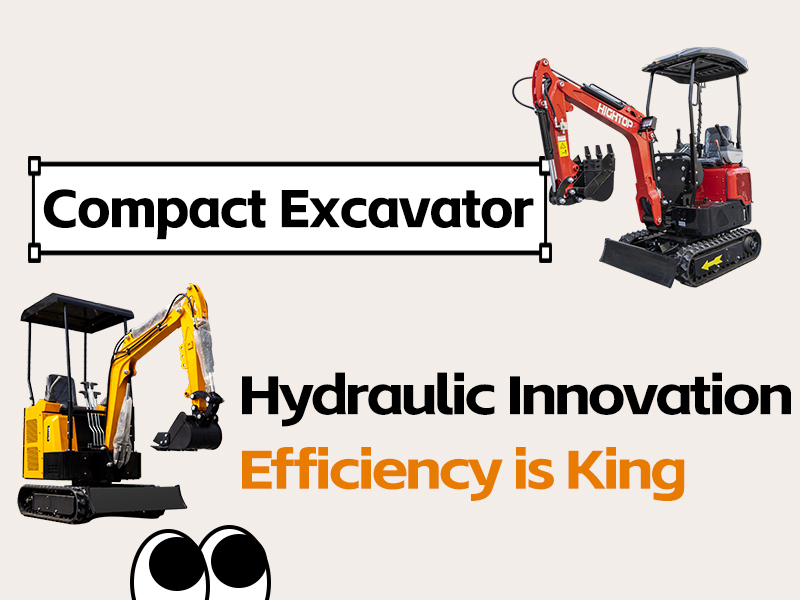
In the construction machinery sector, hydraulic systems are hailed as the “power heart” of excavators, directly determining equipment efficiency, control precision, and energy consumption levels. Particularly in the mini excavator segment, where operators face confined urban workspaces, complex conditions, and energy-saving/environmental requirements, hydraulic system upgrades are pivotal to core competitiveness. As a dedicated pioneer, the company leverages breakthroughs in hydraulic technology R&D to develop high-speed, low-energy, and highly reliable hydraulic systems, revolutionizing small-scale engineering operations.
Mini excavators are widely used in urban landscaping, municipal maintenance, agricultural planting, and other scenarios. Constrained by limited workspaces and variable conditions, they impose stringent demands on hydraulic systems: precise control for fine-tuned operations, rapid energy conversion to reduce consumption, and robust stability to handle load switching.

Traditional mini excavator hydraulic systems suffer from significant shortcomings: First, substantial energy loss—open-loop overflow causes increased fuel consumption and excessive oil temperatures. Second, inadequate control precision—interference during multi-actuator compound movements reduces efficiency. Third, poor adaptability—inability to dynamically match varying load demands.
Addressing these industry pain points, the company collaborated with core suppliers to develop a new-generation intelligent hydraulic system. Through triple upgrades in circuit architecture, core components, and control strategies, it achieves three key advantages:
First, a revolutionary rapid circuit architecture. Abandoning traditional open circuits, it adopts a load-sensing + closed-loop circuit combination design. This real-time matching of actuator load demands enables precise flow distribution, significantly reducing overflow losses. The closed-loop circuit also enhances the system's contamination resistance, adapting to dust interference in complex operating environments.
Second, high-precision core component integration. Equipped with a high-performance axial piston variable displacement pump and premium electromagnetic proportional valves, it delivers rapid response and real-time hydraulic oil flow adjustment to prevent overflow waste. Upgraded cylinder seal structures minimize internal leakage, enhancing system sealing integrity and reliability.
Third, intelligent energy-saving control strategies. Through electronic proportional control and adaptive operating condition algorithms, it dynamically adjusts pump displacement and valve opening, optimizes composite action priority allocation, and reduces operational interference. It achieves intelligent power matching between the engine and hydraulic system, reducing displacement and unnecessary work during idle periods while ensuring digging force under heavy loads. Energy consumption is reduced by 15% under equivalent operating conditions.
In actual operations, the company's mini excavators demonstrate significant advantages. During urban renovation projects in older neighborhoods, precise hydraulic control enables rapid completion of intricate tasks like trench excavation in confined spaces, boosting daily output by 10%. In agricultural greenhouse construction, the machine maintains stable oil temperatures during 8-hour continuous operation, offering longer lifespan and lower maintenance costs than conventional models. User feedback indicates that core hydraulic components come with a 1-year warranty, combined with online monitoring and early warning systems, significantly reducing unplanned downtime.
As the mini excavator market transitions toward intelligent and low-carbon solutions, hydraulic technology innovation is key to competitiveness. The company states it will continue deepening the integration of hydraulic systems with smart technologies to explore faster, more energy-efficient solutions. Through technological breakthroughs, it not only addresses pain points of traditional equipment but also drives the upgrade of small construction machinery. Remaining user-demand oriented, it will continue providing reliable solutions for urban construction, agricultural development, and other scenarios.
Leave a comment